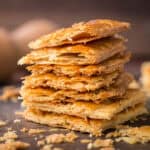
Easy Homemade Gluten Free Puff Pastry
This Gluten-Free Rough Puff Pastry recipe is quicker and easier than regular puff pastry with incredibly crisp buttery, flaky layers. This pastry is suitable for both sweet and savoury uses and is made with a homemade blend of gluten-free flours and no xanthan gum. Makes 560g.
Servings: 12
Calories: 206kcal
Ingredients
- 120 g chickpea flour gram flour
- 80 g cassava flour
- 60 g tapioca flour tapioca starch (plus extra for dusting)
- 2 teaspoons caster sugar promotes browning
- 1 teaspoon kosher salt
- 200 g unsalted butter sliced thinly, cold from the fridge
- 150 g ice cold water
Egg wash (depending on how you are baking the pastry)
- 1 egg yolk
- ¾ teaspoon milk
Instructions
Mix the Dough
- In a large bowl, mix the flours with the sugar and salt.
- Add the cold butter slices into the flour, one piece at the time to make sure each piece is separated and coated with the flour.
- Gradually add the iced water into the flour, 2 tablespoons at a time mixing in with a fork to hydrate the flour. When you have used up all the water, tip the dough out onto a clean work surface and clump the dough together using your (cold) hands, until it just starts to come together into a very loose shaggy dough. Pat into a rectangle about 3-4 inches, 7-10cm thick. The dough will be very crumbly with large butter pieces and plenty of cracks (and you’ll think it doesn’t look right – but it is!).
- Wrap the dough in cling film (plastic wrap) and place it so the long edge is parallel to the edge of your work surface. Using a long rolling pin, beat the dough in the cling film in long even strokes so the dough flattens slightly to 1-2 inches thick.
1st Chilling
- Chill the wrapped dough in the fridge for 2 hours (or up to 48 hours).
Roll and Fold the Dough: 1st turn
- Take two sheets of baking parchment, lay one sheet down and dust lightly with tapioca flour. Remove the dough from the fridge, unwrap, and place onto the baking parchment, with the short edge parallel to the edge of your work surface, gathering up any crumbled pieces and tuck into the dough folds, then dust the top of the dough lightly with tapioca flour. Place the second sheet of baking parchment over the pastry. Use a long rolling pin to smack the dough in the cling film in long even strokes to start flattening out the pastry and make it more pliable. Then start rolling out the dough, beginning with widthways, then ending with lengthways and roll it out to roughly 40cm x 20cm. (twice as long as it is wide).
- Take off the top sheet of baking parchment then fold one of the long ends of the dough up to the centre, using the baking parchment to help you, then fold the other end over it, like closing an envelope.
Rotate and Repeat: 2nd turn
- Position the dough 90 degrees, so the long edge of the dough is parallel to the edge of your work surface, and place the baking parchment back over the top.
- Beat the dough with a rolling pin to help flatten it out again then repeat rolling out of the dough into a rectangle, about 40cm x 20cm.
- Then, as before, fold one long end of the dough up to the centre, using the baking parchment to help, then fold the other end over it.
Rotate and Repeat: 3rd – 6th turn
- Repeat this process of rotating, beating the dough, rolling out and folding until you have completed 6 turns. After the third turn the pastry will be starting to warm up so to keep the butter cold wrap it back up in cling film (plastic wrap) and place into the fridge for 30 minutes to chill again. Then continue with turns 4, 5 and 6.
(Almost) Final Chill
- After the 6 turns chill the dough for 15-30 minutes (or up to 48 hours) before using in your recipe.
Using in Your Recipe
- To use the pastry, remove from the fridge, unwrap, place between two sheets of dusted baking parchment as before, beat with your rolling pin to make it more pliable and then roll out to the shape and thickness as directed in your recipe. Then use as directed.
- Note to chill the pastry for at least 15 minutes before you bake it in the oven.
To Cook a Simple Puff Pastry Sheet
- Pre-heat the oven to 220°C / 200°C fan assisted / gas mark 7 / 425°F.
- If you are just baking the pastry in a simple sheet then make sure the pastry has been chilled for at least 15 minutes (as above) on a lined baking tray.
- Mix the egg yolk and milk together to make an egg wash and brush evenly over the pastry.
- Place the pastry in the oven then immediately lower the heat to 200°C / 180°C fan assisted / gas mark 6 / 400°F.
- Bake for 20-25 minutes until the pastry is crisp and golden brown.
Video
Notes
Flours
I do not recommend swapping the flours for an all-purpose gluten-free flour as the recipe won’t work. If you are stuck with dietary requirements then you can make the following changes:
- Chickpea Flour. You can swap for defatted almond flour (not regular almond flour).
- Cassava Flour. You can swap for sweet rice flour (not regular rice flour).
- Tapioca Starch. You can swap for potato starch (not potato flour).
- The key to this pastry is to keep the dough cold at all times. If at any time during the whole process you think the pastry is getting towards room temperature then put it back into the fridge for 15-30 minutes.
- Beating the chilled dough with your rolling pin prior to rolling it out helps to keep the butter cold whilst making the dough a bit more pliable so you can roll it out without too much resistance.
- Always roll the pastry between two pieces of baking parchment, dusted lightly with tapioca flour.
- Don’t forget to mark each turn you complete – you can mark the pastry itself or use teaspoons transferred into a mug after every turn.
- This recipe makes 560g.
- You need about half (280g) for a tart base to serve 4-6 people.
You need about two-thirds (360g) for a puff pastry pie lid to fit a 23cm (9 inch) pie. - This recipe is the exact amount if you are making a Beef Wellington or Salmon en Croute.
Nutrition
Calories: 206kcal | Carbohydrates: 16g | Protein: 3g | Fat: 15g | Saturated Fat: 9g | Polyunsaturated Fat: 1g | Monounsaturated Fat: 4g | Trans Fat: 1g | Cholesterol: 52mg | Sodium: 203mg | Potassium: 93mg | Fiber: 1g | Sugar: 2g | Vitamin A: 443IU | Vitamin C: 0.3mg | Calcium: 21mg | Iron: 1mg