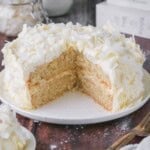
Gluten-Free Coconut Cake
Soft, moist and packed with coconut flavour, this gluten-free coconut cake is an easy layer cake with no xanthan gum.
Servings: 16 people
Calories: 863kcal
Ingredients
- 60 g creamed coconut
- 250 g water
- 60 g desiccated coconut
- 300 g caster sugar
- 240 g coconut oil
- 6 eggs medium
- 160 g almond flour ground almonds in UK
- 80 g coconut flour
- 60 g tapioca flour
- 2 teaspoons baking powder
- ½ teaspoon salt
Coconut Buttercream
- 800 g icing sugar
- 500 g unsalted butter softened
- 60 g whole milk
- 100 g creamed coconut
- ½ teaspoon kosher salt
- 2 teaspoons rice vinegar to make the icing less sweet
- 90 g coconut flakes (raw coconut slices)
Instructions
- Pre-heat the oven to 180°C / 160°C fan assisted / gas mark 4 / 350°F.
- Line and grease 2 x 20cm (8 inch) round cake tins.
- Pour 250g just boiled water into a measuring jug and whisk in the creamed coconut and desiccated coconut until the creamed coconut has dissolved. Allow to rest whilst you prepare the rest of the cake.
- Whisk together the sugar, coconut oil and eggs in a large mixing bowl until completely combined.
- Whisk the flours, baking powder and salt together in a separate mixing bowl.
- Add the flour and coconut mixture alternately, mixing in two additions.
- Divide the cake batter between the two cake tins and bake for 35 minutes. The finished sponges should look golden and just starting to pull away from the sides of the tin. To test to see if it’s baked an inserted cocktail stick should be clean of any wet crumb once removed.
- Allow the cakes to rest in their tins for 5 minutes before carefully removing and cooling completely on cake racks.
Coconut Buttercream
- Warm the milk until just under a boil then whisk in the creamed coconut to create a smooth thick paste. Set aside whilst you prepare the buttercream.
- Place softened butter in the bowl of a stand mixer (food mixer) and whip until ultra creamy and soft for about 5-6 minutes on a medium speed, scraping down the bowl every so often.
- Sift in the icing sugar 1 cup at a time. Stop the mixer each time to bring the bowl out, scrape down and then sift in the icing sugar and whip it into the butter on the lowest speed of the mixer.
- Once all the icing sugar has been added and you’ve scraped the bowl down again so it’s all nicely mixed together, then continue to mix the icing sugar and butter on the lowest setting for 6-7 minutes.
- Add the creamed coconut mixture, salt and rice vinegar and mix for a final 2 minutes to finish.
Assembly
- Place one of the sponge layers on a 20cm (8 inch) cake board, or just directly onto a serving plate (preferably on a cake turntable if you have one), and spread ¼ of the total amount of buttercream over the surface of the sponge,
- Place the second sponge layer on top and cover the top and the sides of the cake with the rest of the buttercream.
- Sprinkle coconut flakes over the top of the surface of the cake.
- Tilt the cake turntable (if you are using one) and press the coconut flakes onto the higher side of the cake sides evenly so the cake is completely covered.
Video
Notes
Coconut oil. You can swap the coconut oil for light olive oil or vegetable oil.
Almond flour swap. If you need the cake to be nut free then you can change the flour blend to the following: 100g sweet rice flour, 80g coconut flour, 60g tapioca starch, 60g white rice flour.
Eggs. The eggs used in this recipe are medium size, 60g each with shell and 50g without shell. If you can't get hold of medium eggs I suggest you weigh the amount.
Buttercream. This is a generous amount of buttercream, you may have some leftover. It can be frozen and used for cupcakes at a later date.
Storing. This cake can be stored in an airtight container in a cool dark place at room temperature (as long as it’s not too warm – in which case it will need to be refrigerated) for up to 3 days. If you have refrigerated it then remove from the fridge for at least an hour to come to room temperature before serving.
Freezing. I recommending just freezing the sponges and filling and covering with the buttercream once thawed on the day of serving. To freeze them, wrap the cooled sponges tightly in cling film (plastic wrap) and then double wrap in aluminium foil. Thaw at room temperature overnight before unwrapping.
Ingredient measurements: Please note when you see ‘grams’ listed as opposed to ‘millilitres,’ or any other term of measurement, that is not incorrect. I weigh all of my ingredients, including liquids, for accuracy.
US customary measurements: These US measurements for the ingredients provided are based on a conversion calculator. This recipe was tested with metric measurements and I recommend using a digital scale to weigh ingredients for the most accurate results. READ MORE >>> Why you should always weigh vs measuring with cups
Nutrition information: Please note that the nutrition information provided below is an estimate based on an online nutrition calculator. It will vary based on the specific ingredients you use. Please seek a professional nutritionist’s advice for further clarification.
The nutrition serving is for 1 slice of cake, assuming the cake is cut into 16 servings, which are very generous slices. You can certainly make the cake go further, particularly if you cut it party style.
Nutrition
Calories: 863kcal | Carbohydrates: 82g | Protein: 6g | Fat: 61g | Saturated Fat: 42g | Polyunsaturated Fat: 2g | Monounsaturated Fat: 9g | Trans Fat: 1g | Cholesterol: 129mg | Sodium: 194mg | Potassium: 195mg | Fiber: 4g | Sugar: 69g | Vitamin A: 876IU | Vitamin C: 0.3mg | Calcium: 70mg | Iron: 2mg