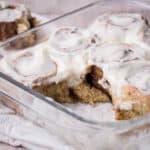
Soft & Fluffy Gluten-Free Cinnamon Rolls (no xanthan gum)
These Gluten-Free Cinnamon Rolls are soft and fluffy and made with an easy homemade flour blend and no xanthan gum. They are an incredible treat, sticky with buttery cinnamon with a gorgeous cream cheese frosting. Follow these detailed instructions and you’ll be convinced this version is just as delicious as any you’ve had and easier to make than you think.
Servings: 9 cinnamon rolls
Calories: 666kcal
Ingredients
Gluten-Free Dough
- 160 g whole milk
- 60 g soft light brown sugar
- 7 g dry active instant yeast
- 20 g psyllium husk not ground
- 200 g water
- 290 g almond flour ground almonds in UK
- 180 g tapioca flour plus extra for flouring and rolling out the dough
- 180 g sorghum flour
- ½ teaspoon baking powder
- ¼ teaspoon bicarbonate of soda
- ½ teaspoon salt
- 60 g unsalted butter melted
- 1 tablespoon apple cider vinegar
- 1 egg medium
Cinnamon Filling
- 125 g butter room temperature
- 120 g soft light brown sugar
- 2 tablespoon cinnamon
- 2 teaspoons vanilla extract
- ⅛ teaspoon salt
Cream Cheese Frosting
- 120 g cream cheese
- 90 g icing sugar
- 1 tablespoons whole milk
- 1 teaspoon vanilla extract
- ¼ teaspoon salt
Instructions
Activate the yeast
- Pour the milk into a small saucepan and heat to between 38-46°C (100-115°F).
- Pour the warm milk into a medium-sized glass bowl.
- Stir in the yeast and brown sugar. Let the mixture rest for 10 minutes until the surface becomes thick and bubbly.
Create psyllium gel
- Stir the water and psyllium husk together in a medium sized mixing bowl until combined.
- Allow to stand for 2-4 minutes until it forms a gel.
Prepare the cinnamon roll dough
- Whisk together the dry ingredients (almond flour, sorghum flour, tapioca flour, baking powder, bicarbonate of soda and salt) in the bowl of a stand mixer.
- Add the wet ingredients into the dry ingredients (the yeast milk mixture, the psyllium husk gel, apple cider vinegar, melted butter and egg) and mix together on a medium speed for about 5 minutes.
- Scrape the dough out onto a lightly floured (tapioca flour) surface and using floured hands (tapioca flour) shape the dough into a smooth ball. If the dough is still a little too sticky for this just flour your hands again and keep shaping.
Prove the dough (1st rise)
- Place the dough ball in a clean mixing bowl and cover with a tea towel or with cling film. Rest in a damp warm place* for 1½ hours to prove. The dough should have almost doubled in size.
Roll out the dough
- Cut a long piece of parchment paper into a 12” x 18” (30 x 45cm) rectangle and dust it lightly with tapioca flour.
- Using (tapioca) floured hands, scoop the dough out of the bowl and lightly smooth out and shape into a large doughy ball on a lightly floured work surface then lift the dough onto the middle of the floured parchment.
- Flatten the dough out slightly using your hands then continue to roll out the dough (lightly floured with tapioca) using a rolling pin until the dough is also 12” x 18” (30 x 45cm) in size.
Make the filling
- Place all the filling ingredients in a bowl and mix together until fluffy and smooth.
Add the filling to the dough
- Drop spoonfuls of the filling evenly across the surface of the dough. Spread the filling out, carefully and evenly, to the edges, using a spatula.
Roll up the dough
- Tightly roll the dough into a long log, using the baking parchment underneath to lift and roll the dough which keeps the dough from cracking. Use your hands to smooth the baking parchment along the length of the log as you go to keep it even in size. Finish the roll with the seam down.
Divide the dough
- Score the dough into 9 x 2 inch (5cm) pieces using a sharp knife, starting a little after the raggedy ends as you'll be discarding these. Then using a long strand of dental floss or thread, slide it under the log and cut out the even-sized rolls by pull the thread over and across each other for neat cuts. Discard the raggedy ends.
- Place the rolls into a 9 x 9 inch (23 x 23cm) square buttered baking dish, evenly space apart and cut side up.
Prove the dough (2nd dough rise)
- Cover the dish with a tea towel or cling film and place somewhere warm and damp to prove for a final 40 minutes until they have increased in size so they are just touching each other.
Bake
- Pre-heat the oven to 180°C / 160°C fan assisted / gas mark 4 / 350°F. Bake the cinnamon rolls for 30 minutes until golden brown.
Prepare the frosting
- Place all the ingredients in a medium sized bowl and whisk together until smooth – about 30 seconds.
Add the frosting and cool
- Remove the rolls from the oven, allow them to cool for 5-10 minutes then pour over the frosting evenly and serve.
Video
Notes
Egg. The egg used in this recipe is medium size, 60g with shell and 50g without shell. If you can't get hold of medium eggs I suggest you weigh the amount.
Almond Flour. This recipe calls for almond flour which is blanched and ground whole almonds (without their skin). In the UK this kind of flour is sold in most major UK supermarkets labelled 'ground almonds' in the baking aisle. To make sure you know which almond flour you are choosing then check against this article The Difference Between The Almond Flours. I don't recommend a substitution for the almond flour.
Sorghum flour. You can substitute for oat flour.
Tapioca flour. You can substitute for cassava flour.
Sticky dough. The dough should still be a little sticky but don't worry as more tapioca flour gets added along the process. Dust the work surface and your hands with tapioca flour as you scrape the dough out of the mixer and shape the dough into a smooth dough. Dust your hands and the work surface a little more if it’s too sticky to smooth together.
Proving the dough. My favourite way which has never failed me is to place the covered dough in the oven on the middle shelf with a tray of just boiled water placed on the bottom of the oven to create a warm, steamy atmosphere that helps the yeast do its job and make the dough rise even faster.
Soft dough. This is a very soft dough so needs lightness of touch when you are handling it and that’s why the parchment is such a useful tool as you don’t need to touch it too much.
How to Make Ahead and Store: If you want to make them in advance the best way is to prepare them all the way up to the second proof the day before. Then the cinnamon rolls can complete their second proof overnight in the refrigerator and you can bake them the next day.
The best way to store them if they are frosted is to keep them in their baking pan and cover them then store in the refrigerator for up to 3 days. Re-heat the cinnamon rolls individually to enjoy.
Re-heating cinnamon rolls: The best way to re-heat individual cinnamon rolls is in the microwave. Place the cinnamon roll in a microwave proof bowl and cover then cook on high power for 60 seconds (straight from the fridge) or 30 seconds if it is already at room temperature.
How to Freeze: They are best to freeze before baking. Complete all the steps, including the first rise of the dough, rolling it out, adding the filling, cutting into rolls and placing in the baking pan. Then double wrap the baking pan tightly with cling film (plastic wrap) and aluminium foil then freeze for up to 2 months. Thaw the pan of cinnamon rolls in the fridge overnight, then remove from the fridge and complete the 2nd rise by unwrapping the rolls, re-covering the pan in cling film or a tea towel and placing somewhere warm to proof for 1 ½ - 2 hours. Then bake as directed.
Ingredient measurements: Please note when you see ‘grams’ listed as opposed to ‘millilitres,’ or any other term of measurement, that is not incorrect. I weigh all of my ingredients, including liquids, for accuracy.
US customary measurements: These US measurements for the ingredients provided are based on a conversion calculator. This recipe was tested with metric measurements and I recommend using a digital scale to weigh ingredients for the most accurate results. READ MORE >>> Why you should always weigh vs measuring with cups
Nutrition information: Please note that the nutrition information provided below is an estimate based on an online nutrition calculator. It will vary based on the specific ingredients you use. Please seek a professional nutritionist’s advice for further clarification.
The nutrition serving is for 1 cinnamon roll.
Nutrition
Calories: 666kcal | Carbohydrates: 75g | Protein: 11g | Fat: 39g | Saturated Fat: 15g | Polyunsaturated Fat: 1g | Monounsaturated Fat: 6g | Trans Fat: 1g | Cholesterol: 78mg | Sodium: 411mg | Potassium: 185mg | Fiber: 7g | Sugar: 32g | Vitamin A: 756IU | Vitamin C: 0.1mg | Calcium: 166mg | Iron: 3mg