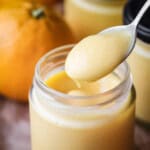
Orange Curd
Silky zesty orange curd made from fresh seasonal oranges is a beautifully buttery preserve. Perfect at breakfast time, for filling cakes or with a batch of fresh scones.
Servings: 30
Calories: 68kcal
Ingredients
- 3-4 large oranges unwaxed, about 600-700g
- ½ lemon unwaxed
- 150 g white sugar
- 200 g whole eggs 4
- 40 g egg yolks 2
- 120 g unsalted butter cold and cut into small cubes
- Pinch of sea salt
Instructions
- Zest and juice the oranges and half the lemon. You need to end up with 200g fresh juice.
- Pour the citrus juice, zest and sugar into a medium saucepan. Turn the heat on and whisk everything together whilst bringing to a gentle simmer then remove from the heat.
- Break the eggs and egg yolks into a medium sized mixing bowl, weigh to make sure they make up to 240g. Lightly beat together then pour a splash of the hot orange mixture into the beaten eggs, whisking vigorously to avoid the egg scrambling.
- Gently pour the rest of the mixture into the eggs in a steady stream whisking all the time until the eggs and citrus mixture is completely combined.
- Pour it all back into the saucepan, along with the salt, and turn the heat to lowest setting. Stir the curd with a wooden (or silicone) spoon, making sure to swirl gently into the corners, touching the bottom of the saucepan so the curd doesn’t settle there otherwise it will start to curdle.
- Continue stirring until the curd starts to thicken which can take at least 15 minutes. You don’t want it to boil which will be when the mixture gets past 80°C (176°F) so if you have a digital thermometer you can keep an eye on it as well as feel for the turn in texture. The curd is ready when it starts to feel a little heavier and thicker to stir, almost like a pourable custard. It should coat the back of your wooden spoon. Dip it into the curd and run a finger down the back of it, if a clear line is left on your spoon then your curd is ready.
- Remove the orange curd from the heat and strain into a large measuring jug so the curd is very smooth.
- Drop the cold cubed butter into the curd and blend with an immersion (handheld) blender until glossy and smooth.
- Place the measuring jug in a large saucepan and fill the sides with ice and cold water to create an ice bath. Allow the curd to cool in the measuring jug set in the ice bath for 15 minutes.
- Pour the curd into sterilised jars, seal and place in the fridge to cool and set overnight.
Notes
Makes enough to fill 3 x 190ml jars.
Oranges
Blood oranges and Navel oranges are very juicy and work well in a curd. Cara Cara oranges which are harder to find have a lovely sweetness but don’t yield as much juice. Try swapping a navel orange for a Seville orange to get more of a complexity of flavour.
If your oranges are not very juicy so you find you need to use more of them to achieve 200ml juice, then bear in mind you’ll still only want to zest 4 of them – otherwise the curd can start to lean toward too zesty.
Eggs
You need 240g beaten eggs. Make this up with 4 x whole eggs and 2 x egg yolks.
Tips and Troubleshooting
- Pour the heated citrus sugar into a measuring jug to pour over the beaten eggs, that way you add the hot liquid in an ultra slow stream. The eggs will slowly temper and get incorporated into the citrus sugar. This avoids potential egg scramblage.
- If the eggs do scramble a little, don’t worry, you will be straining the curd at the end of the process so any small strings of cooked egg will be discarded.
- If the egg completely scrambles then you may need to begin again.
- Set the egg bowl on a damp cloth to steady it and avoid the bowl spinning around the work surface.
- When you remove the finished curd from the heat it will still be pourable and not the thickly set consistency. This is normal, your curd will set and thicken as it cools.
- Here is my Guide For Sterilising Jam Jars and Lids for full advice.
- Orange Curd will keep for up to 2 weeks in the fridge.
Nutrition
Calories: 68kcal | Carbohydrates: 7g | Protein: 1g | Fat: 4g | Saturated Fat: 2g | Polyunsaturated Fat: 0.3g | Monounsaturated Fat: 1g | Trans Fat: 0.1g | Cholesterol: 48mg | Sodium: 11mg | Potassium: 38mg | Fiber: 0.4g | Sugar: 6g | Vitamin A: 185IU | Vitamin C: 8mg | Calcium: 12mg | Iron: 0.2mg